

The World Health Organization (WHO) has officially withdrawn Spain’s status as a measles-free country, citing evidence that sustained transmission of the virus may have resumed after several years of epidemiological control. Spain had held the measles elimination certification since 2017, following more than three consecutive years without endemic circulation.
The decision was communicated to the Spanish Ministry of Health by the European Regional Verification Committee for Measles and Rubella Elimination, an independent expert body linked to the WHO. After analysing epidemiological and laboratory data from 2024, the committee concluded that ongoing viral circulation within Spain could not be ruled out, particularly due to the possibility of transmission chains lasting longer than 12 months.
Health authorities confirmed that 227 measles cases were recorded in Spain in 2024, a sharp increase compared with 11 cases in 2023. Preliminary figures for 2025 suggest the upward trend continues, with nearly 400 diagnoses reported so far.
Vaccination gaps and increased international exposure
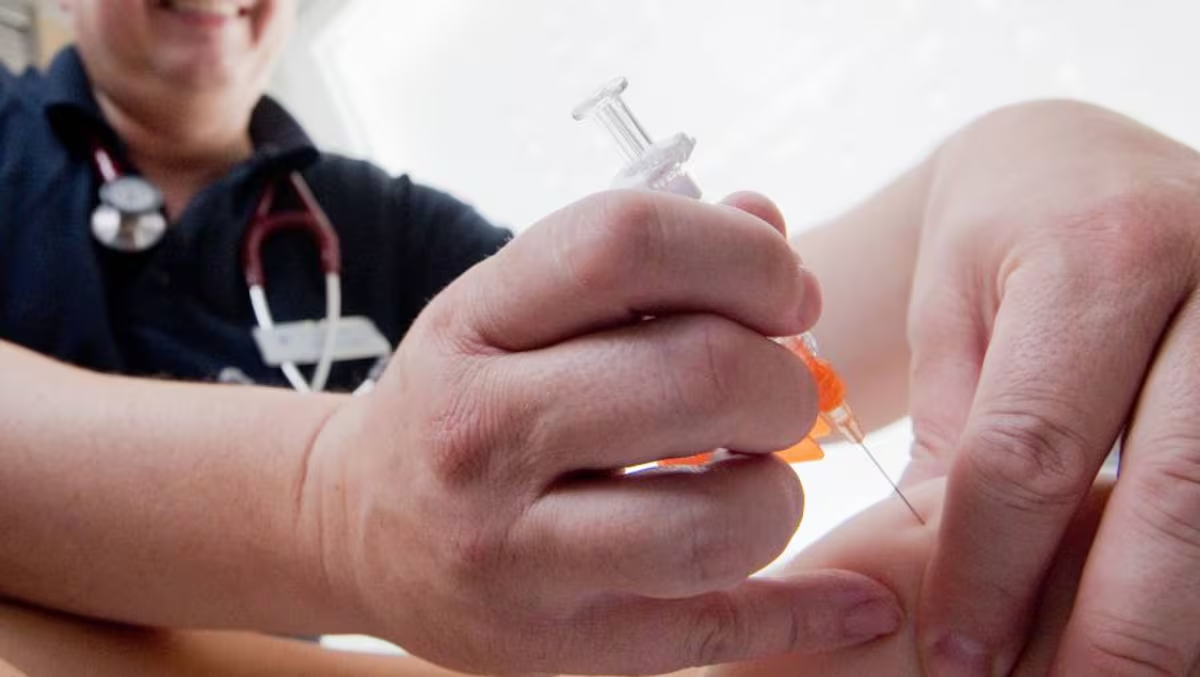
Despite the setback, Spanish health officials emphasise that the country continues to maintain high overall vaccination rates. The measles, mumps and rubella (MMR) vaccine — administered in two doses — remains the cornerstone of prevention. However, coverage for the second dose remains below the 95% threshold recommended by the WHO to prevent outbreaks of such a highly contagious virus.
According to Spain’s Centre for Coordination of Health Alerts and Emergencies (CCAES), improvements are needed both in vaccination uptake and in the sensitivity of disease surveillance. Rapid identification and investigation of suspected cases are considered critical, particularly in a context of intense international travel and high virus circulation in neighbouring countries.
The European Centre for Disease Prevention and Control (ECDC) has also reiterated its recommendation that citizens across Europe verify their vaccination status before travelling abroad, noting that immunity from the MMR vaccine takes at least two weeks to develop.
A broader European and global trend
Spain is not alone in losing its measles elimination status. The WHO reports that several other countries, including the United Kingdom, Austria, Armenia, Azerbaijan and Uzbekistan, have experienced a return of sustained measles transmission. In addition, France, Germany and Italy have shifted from interrupted transmission to persistent circulation of the virus.
Across the European region, the resurgence of measles has been largely attributed to declining vaccination coverage. Data from the ECDC indicate that 87% of measles cases reported in Europe in 2024 occurred in unvaccinated individuals, while only a small fraction involved people who had received both vaccine doses.
Imported cases and hidden transmission chains
In Spain, most identified measles cases have been linked to imported infections, often originating from countries experiencing major outbreaks, such as Morocco and Romania. However, Spanish authorities acknowledge that in nearly one-third of cases reported in 2024, the source of infection could not be determined, raising concerns about undetected local transmission.
Although no case has been definitively classified as resulting from endemic circulation, the WHO has stated that the available data do not allow this possibility to be excluded.
Falling vaccination coverage: a global health challenge
Public health experts warn that the global resurgence of measles reflects a combination of factors, including disruptions to healthcare services during the Covid-19 pandemic, armed conflicts affecting health systems, and the growing impact of vaccine misinformation, particularly in high-income countries.
The WHO stresses that even a modest decline in vaccination coverage can create conditions for explosive outbreaks. In Romania, for example, immunisation rates have dropped to approximately 62%, contributing to the majority of measles cases reported in Europe in 2024.
In Spain, first-dose MMR coverage reached 97.3% in 2024, while second-dose coverage stood at 93.8%, with notable regional disparities. Several autonomous communities reported coverage levels below 90%, leaving pockets of susceptible individuals.
Reinforcing prevention efforts
Spanish health authorities have reaffirmed their commitment to eliminating measles and regaining WHO certification. The Ministry of Health has announced plans to strengthen vaccination campaigns and update the National Strategic Plan for Measles and Rubella Elimination.
Officials also clarified that the loss of measles-free status does not affect rubella, for which Spain continues to meet elimination criteria.
While experts expect the likelihood of exposure to increase in the short term, authorities maintain that the overall risk to the general population in Spain remains low, provided high vaccination coverage is sustained and surveillance systems remain robust.