

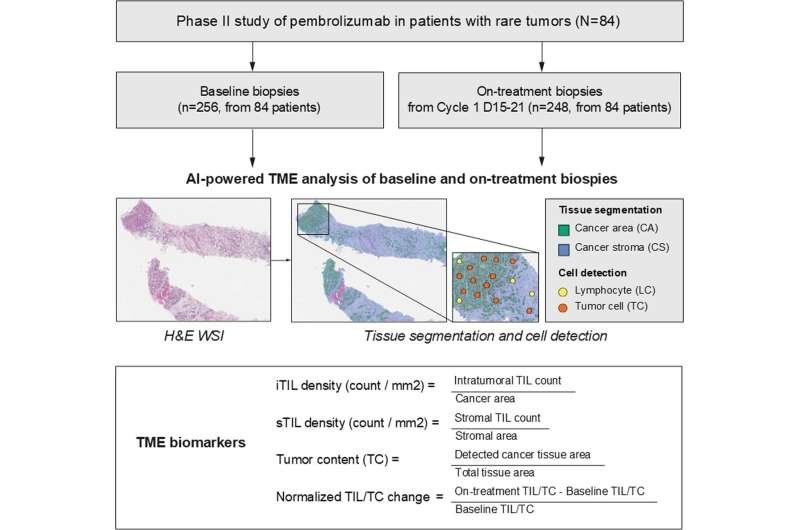

Researchers in the United States have developed an artificial intelligence (AI)-based pathology approach that may improve the prediction of how patients with rare cancers respond to immunotherapy. The study, conducted by scientists at The University of Texas MD Anderson Cancer Center and published in the Journal for ImmunoTherapy of Cancer, demonstrates that AI can extract clinically meaningful information from standard tumour biopsy slides, potentially supporting more personalised cancer treatment in the future.
Although the findings are encouraging, investigators emphasise that the technology requires further validation in larger clinical studies before it can be incorporated into routine medical practice.
Using Artificial Intelligence to Analyse the Tumour Microenvironment
Immunotherapy has transformed the treatment of several cancers by stimulating the body's immune system to recognise and destroy malignant cells. However, predicting which patients will respond remains a significant clinical challenge, particularly for individuals with rare cancers, where established predictive biomarkers are often lacking.
The research focused on analysing the tumour microenvironment—the complex network of immune cells, blood vessels and surrounding tissues that interact with cancer cells. Previous investigations by the same research team identified two biological characteristics associated with improved responses to immunotherapy: the number of immune cells already present within the tumour before treatment and changes in immune cell infiltration after therapy begins.
Traditionally, measuring these features requires detailed manual examination by pathologists, a process that is labour-intensive and difficult to perform across large patient populations. The AI system was designed to automate this analysis using routinely collected pathology slides, enabling faster and more consistent evaluation.
Combining Biological Markers Improves Prediction
The study found that two indicators were particularly informative when assessed together. Patients whose tumours showed increasing immune cell infiltration during treatment alongside a reduction in tumour content experienced substantially better clinical outcomes than those without these characteristics.
According to the researchers, individuals displaying both favourable biological signals had a 64% lower risk of disease progression or death. Median overall survival also differed markedly, with these patients surviving approximately 42 months, compared with 10 months among patients who did not exhibit the same pathological features.
The investigators believe that combining these measurements provides a more comprehensive assessment of treatment response, reflecting both activation of the immune system and a reduction in tumour burden.
Advantages of AI in Cancer Diagnostics
One of the major strengths of this approach is its reliance on standard pathology specimens that are already obtained during routine cancer care. Rather than requiring additional laboratory procedures or specialised testing, the AI platform analyses existing biopsy slides, potentially making the technology more practical for widespread clinical use if future studies confirm its effectiveness.
Artificial intelligence also allows repeated assessment of tumour samples collected throughout treatment, enabling clinicians to monitor changes over time with greater efficiency than manual analysis alone.
Further Clinical Validation Remains Essential
Despite the promising results, the researchers caution that the technology is still in the investigational stage. Larger studies involving broader patient populations will be necessary to determine whether AI-guided pathology analysis can reliably support treatment decisions across different rare cancer types.
Experts note that AI is intended to complement—not replace—the expertise of pathologists and oncologists. Instead, it may provide an additional source of objective information to help clinicians select the most appropriate therapies for individual patients.
As research into digital pathology and artificial intelligence continues to expand, studies such as this highlight the growing potential of computational tools to advance precision oncology and improve personalised care for patients with rare cancers in the United States and around the world.