

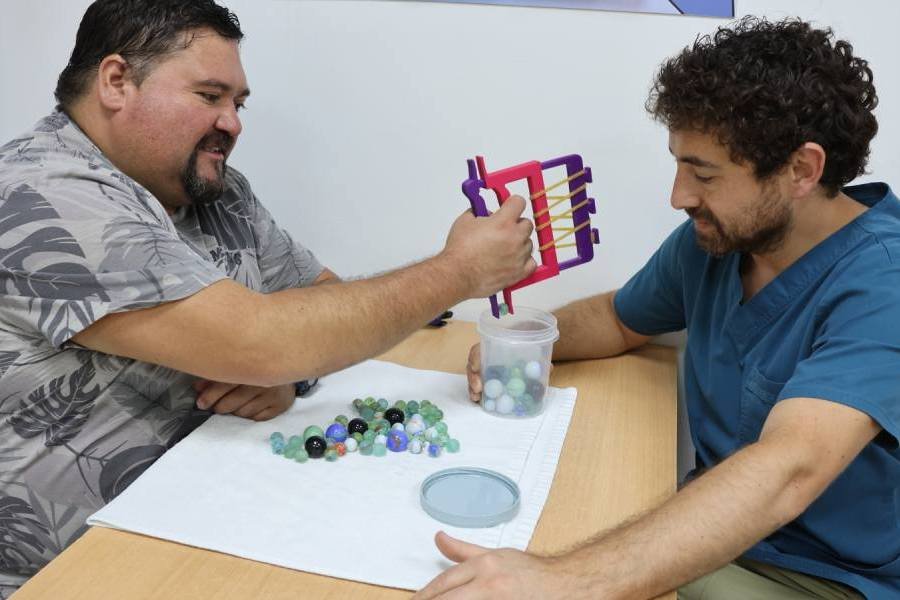
The integration of 3D printing technology into rehabilitation services is transforming patient care in Chile, particularly within the public healthcare system. At the Herminda Martín Clinical Hospital (HCHM), the Physical and Rehabilitation Medicine Service has strengthened its therapeutic capacity through the design and production of personalised assistive devices using additive manufacturing.
The initiative, led by the hospital’s in-house 3D Printing Laboratory, was expanded following the allocation of funding under the Second Innovation and Efficiency Challenge, a national programme aimed at improving healthcare delivery. The project was developed by physiotherapists Fabián Bustos and Alexis Canto, alongside occupational therapist Valentina Muñoz, all members of the hospital’s rehabilitation team.
Tailored solutions for daily living and therapy
According to Valentina Muñoz, 3D-printed assistive devices are specifically designed to enhance autonomy in everyday activities. These include practical tools such as button hooks, key adaptors, nail clippers, can openers and universal grip aids. In addition, the technology enables the production of rehabilitation equipment used in therapeutic sessions, including hand and finger grips, pronation–supination tools and functional training boards.
Although the hospital had access to 3D printing technology prior to 2024, the newly awarded project funding enabled the acquisition of a Bambu Lab X1 Carbon printer and additional materials. This upgrade significantly improved production efficiency, reducing printing times by more than 60% and accelerating delivery to patients.
Measurable impact on access and efficiency
Since the introduction of the new equipment, approximately 20 patients have received nearly 40 personalised assistive devices for home use. In outpatient and inpatient settings, an estimated 115 individuals benefit daily from these tools during rehabilitation processes across services such as Physical and Rehabilitation Medicine, Neurology, Internal Medicine, Adult Critical Care and General Surgery.
From a management perspective, one of the most significant outcomes has been the reduction in waiting times. The average delivery period for assistive devices decreased from around 30 days to just over three days, representing a 78.5% reduction compared to the previous system.
Addressing complex rehabilitation needs
The 3D-printed devices primarily support patients with neurological conditions, including stroke, Parkinson’s disease and spinal cord injuries. They are also used in cases involving rheumatological and degenerative disorders, such as rheumatoid arthritis and hand osteoarthritis, as well as in post-surgical and post-traumatic recovery, including fractures, tendon injuries and scar management.
Alexis Canto highlights that the key advantage of 3D printing in rehabilitation lies in the ability to co-design devices tailored to each patient’s anatomy, strength, mobility and functional goals. This iterative process allows for continuous adjustments until the solution meets clinical and personal needs. Evidence from clinical practice suggests that such personalised interventions contribute directly to improved independence, social participation and overall quality of life.